
The Most Underrated Training Tool is One You Already Have
A leash is where training starts, not where it lives

Maple!
Hey! Maple! Down!
She sits.
No, down.
She stays in sit.
No, down.
She stays in sit.
Argh. I go over to her, curtsy toward the floor, snap my fingers and tell her to down. It’s a non-negotiable.
She lies down.
I go back to preparing dinner for the five dogs I have in my custody when I hear nails tapping slowly across the floor, coming toward me. I know it’s Maple without having to look. The other dogs are all waiting patiently, pools of drool collecting on the floor where they lie.
Maple!
Rather than repeat the same pointless game from above, I grab a slip lead and lasso it over her neck like I’m some kind of cowboy, bring her with me and tell her to lie down.
She sits.
She’s ready to play chicken again. I’m prepared this time.
No, down, I say as I make a “J” shape with the leash and step on the curved part with my foot. I keep it there to enforce the down while I finish preparing the dogs’ food.
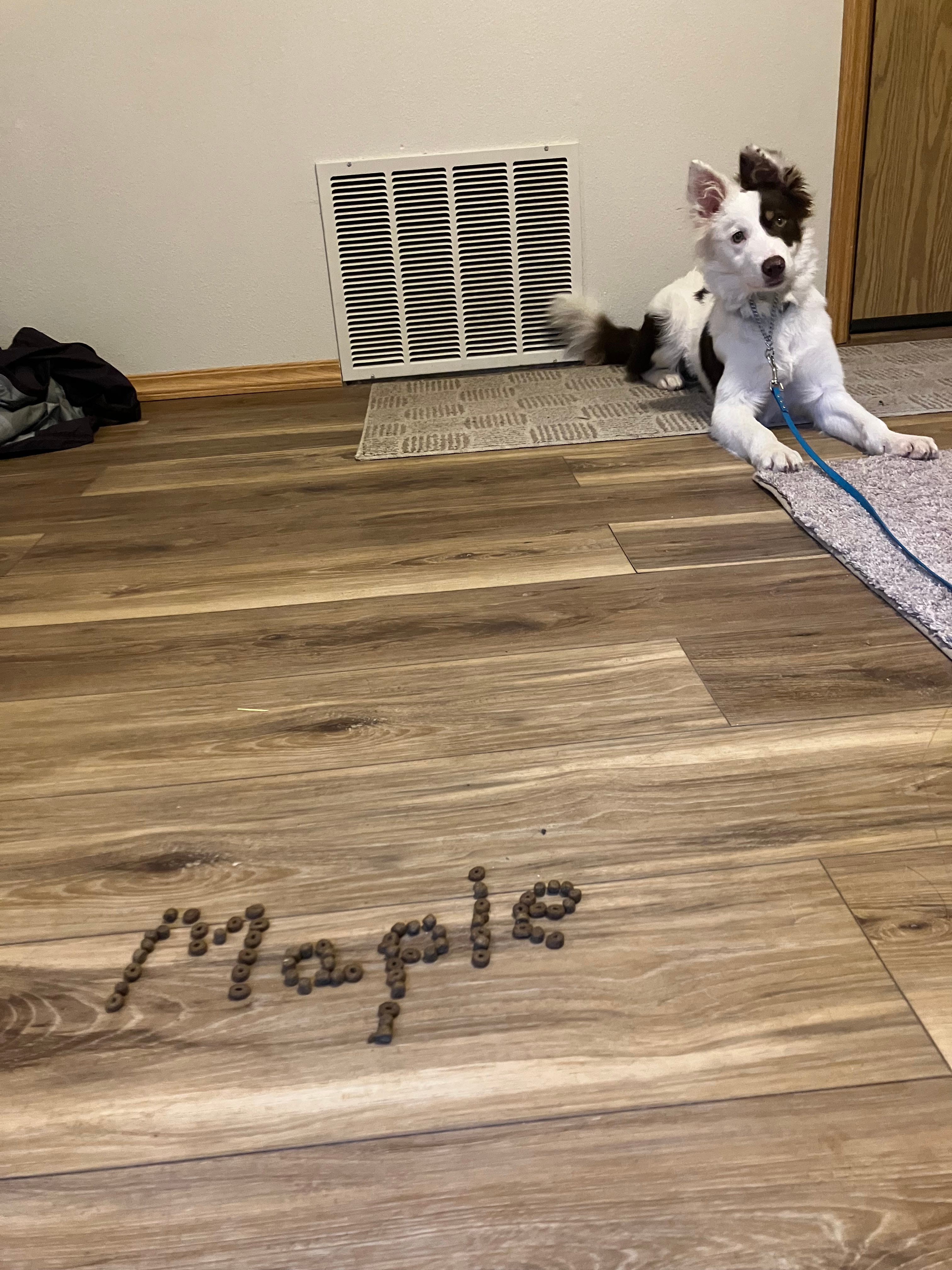
Maple is a 7-month old Border Collie puppy (and baby sis to Alpine) that I raised until she was four months old. She’s a delight and her owners do an excellent job maintaining her training, but at the end of the day, she’s a puppy who is still learning and building endurance in behavior. And also, she loves to eat.
I’ve played this game with dogs too many times, testing their skills before they’re ready, usually out of laziness on my part. I inevitably wind up frustrated with their lack of obedience, acknowledging it’s entirely my fault and that I have a wonderful tool at my disposal to eliminate this whole occurrence.
That tool is the leash.
When I have a new dog, and especially a puppy, if they’re not in their kennel, the leash is on. It’s on when we’re inside the house and when we’re outside training. It’s on when we play and when we go for adventures.
One of the biggest mistakes dog owners make is ditching the leash too soon.
It plays huge role in training and communication in the beginning stages of working with a new dog.
Everything Comes Down to Leash
There’s a Scrubs episode that’s musical-themed. One of the songs is called “Everything Comes Down to Poo.” The song explains that just about every medical issue can be explained by the consistency of one's poop.
When I’m answering questions from my clients, this song comes to mind, only I change the title to “Everything Comes Down to Leash.” It’s not quite as catchy and certainly not as funny, but it’s true.
My dog won’t go into the crate, how do I get them to go in?
Leash.
My dog runs away with the ball when we play fetch, how do I get them to come back?
Leash.
My dog keeps bothering the cat, how do I make them stop?
Leash.
My puppy takes forever to go potty outside because they get so distracted, how can I get them to potty quicker?
Leash.
I have to pick up my [insert athletic dog breed that most certainly can jump] to get them to go into the car.
Oh hell, nah. Use a leash!
When your dog is learning new behaviors or being asked to do things that are much less fun than the thing they would rather be doing (like biting your child’s pants) or feign that they cannot do (Parental unit, I simply cannot go down the stairs), the leash is the way to show them what you want.
A lot of dogs, upon realizing that today is the day you actually mean what you say, will stage a protest of such epic proportions the ACLU will take note. The screaming and flopping would make any footballer look like an amateur.
Others will take the opportunity to audition for the role of opossum and fake their own death, going completely limp on the floor like their skeleton just left the building.
This is part of the learning process and while it can be dramatic, it’s creating clarity.
Lost in Translation
When you’re teaching your dog new behaviors you want, the leash is the best–and sometimes only–way to stay accountable.
The leash is your translator.
Dogs don’t speak English and their primary way of communication is through touch. Humans communicate primarily with words.
If you watch me work with dogs, you’ll notice that I say very little to them. I speak with the leash and with my body movement and positioning.
When I am teaching a dog something new, the leash allows me to show them what I want. I can guide them to a position or apply pressure in the direction I want them to go. It is very clear to the dog.
Mean What You Say and Say What You Mean
Dogs learn quickly when we don’t mean what we say.
I have couples complain to me all the time that their dog listens better to one over the other. It’s not personal, the dog has simply done the math. One owner means it, the other is offering a suggestion.
If you don’t have a leash on your dog and you tell them to come, how are you going to get them to come back to you if they choose not to?
More often than not, they’re going to chose to ignore you because that smell, dog, deer, whatever is WAY more exciting than returning to you.
The leash is your must key. You must come back when I say “come.”
If you don’t have that physical connection to your dog, then the word “come” (or any command) has no meaning.
The Leash is the Classroom
Once your dog has become fluent with the vocabulary, meaning they do the command you ask, every time, in every context, the leash can become optional.
Most dogs never get to leave the classroom because their owners never finish the course.
It’s like learning a new language.
If you took Spanish in high school and now you’re 40 and try to use what you learned 25 years ago on your next trip to Spain, you’re going to struggle.
You’ll have to look up every word, memorize the sentence before you say it, and speak really slowly so you don’t trip over your words.
But if you had continued practicing beyond high school, you’d be fluent and have no problem getting around a Spanish-speaking country without the extra work.
It takes consistency and quality repetitions to master a skill.
My response to my clients when they ask how long they need to practice XX skill? ABT. Always. Be. Training.
The Training Has Only Just Begun
Now, the whole premise of my brand is to have dogs off-leash trained so they have more freedom. The leash is where training starts, but not where it ends.
I wrote recently about the reasons I think leash laws cause more harm than good.
I believe that most dogs have the capability to be off-leash. Some dogs require more work than others, depending on how strong existing habits are already ingrained in the dog’s memory bank and what kind of genetics they possess.
What it takes to be off-leash reliable is consistency and meaning what you say.
Your dog is not stubborn.
They ignore you because you allow them to do so.
But it doesn’t have to be that way.
Everything comes down to leash.
If this is the first time you’ve read me — welcome. Each week I publish one essay about what mainstream dog culture gets wrong and what actually works. Subscribe below so you don’t miss the next one.
I wasn't trying to argue something specific, more just trying to clarify. Yes, I consider crates, leashes, gates, etc. to be management tools because they're primarily used to prevent unwanted behaviors.
So, in the recall example, I can certainly get the dog to return to me using a leash by applying pressure (ideally as little as can be effective, and not jerking but consistent). And there's nothing wrong with that. But when I apply pressure, they come, and then I reinforce, usually in the dog's mind what's being reinforced is responding to the leash pressure. An off leash recall requires proper motivation.
The vast majority of the training process involves understanding what your dog finds reinforcing. Sometimes it's food. Sometimes it's play. Other times they just want to be close to their person. Anything can be reinforcing, we just have to dig a little to discover it. For instance, sniffing (since we were talking about sniffaris earlier) can be used to reinforce wanted behavior. I put my dog on a leash, he sees a bush he really wants to sniff, so I call him to me (a bush outside is probably something we'd build up to but it's the same premise), when he completes the recall on his own volition, i mark it and then we move together to allow him to sniff the bush. The thing he wants in the moment becomes the reinforcer for what I'd like him to do first (it's called the Premack principle).
Having a leash on absolutely sets them up for success and prevents potentially dangerous or tragic choices, but it's finding the appropriate motivator in that moment that helps the dog see that his choices matter and by engaging with me politely we can all get what we want.
I find our guy Jack responds immediately, always, when the prong collar is on. In fact, just putting it on him, he acts differently, more aware of us, and less “ doing his own thing”. We don’t keep it on— we use it mainly on walks. But when he uses just a regular collar and the leash I find he does not respond nearly as quickly or effectively to commands and gestures.